Posts Tagged ‘evolution’
Nov. 21, 2012 | Filed under: Media Release | Tags: Andrew Trites, conservation, diet, dolphins, evolution, marine mammals, research excellence, sustainability, whales
In the marine world, high-energy prey make for high-energy predators. And to survive, such marine predators need to sustain the right kind of high-energy diet. Not just any prey will do, suggests a new study by researchers from the University of British Columbia and University of La Rochelle, in France.
Read More ...
Sep. 25, 2012 | Filed under: Media Release, News Feed | Tags: evolution, Faculty of Science, geolocator, migrating birds, NSERC, research excellence, sustainability, zoology
By outfitting two British Columbia subspecies of Swainson’s thrushes with penny-sized, state-of-the-art geolocators, University of British Columbia researchers have been able to map their wildly divergent migration routes and pinpoint conservation hotspots.
Read More ...
Jul. 18, 2012 | Filed under: Media Release, News Feed | Tags: biodiversity, Biodiversity Research Centre, evolution, Faculty of Science, FoS, research excellence
Two species of single-cell parasites have co-opted “ready-made” genes from their hosts that in turn help them exploit their hosts, according to a new study by University of British Columbia and University of Ottawa researchers.
Read More ...
Apr. 1, 2012 | Filed under: Media Release, News Feed | Tags: CRC, evolution, Faculty of Science, FoS, mate preference, sexual selection, sustainability, zoology
Picky females play a critical role in the survival and diversity of species, according to a Nature study by researchers from the University of British Columbia and the International Institute for Applied Systems Analysis (IIASA) in Austria.
Read More ...
Jan. 23, 2012 | Filed under: Media Release, News Feed, News Tip | Tags: business, cultural anthropology, evolution, Joseph Henrich, marriage, monogamy, Polygamy, polygyny, Psychology, Science
In cultures that permit men to take multiple wives, the intra-sexual competition that occurs causes greater levels of crime, violence, poverty and gender inequality than in societies that institutionalize and practice monogamous marriage.
Read More ...
May. 24, 2011 | Filed under: Media Release, News Feed, Uncategorized | Tags: Alec Beall, bad boys, business, Culture, emotions, evolution, gender, happiness, health, Jessica Tracy, marketing, Marlon Brando, pride, Psychology, relationships, research, Robert Pattinson, Science, sex, sexual attraction, shame, Social Sciences
Women find happy guys significantly less sexually attractive than swaggering or brooding men, according to a new University of British Columbia study that helps to explain the enduring allure of “bad boys” and other iconic gender types.
Read More ...
Mar. 30, 2011 | Filed under: Media Release, News Feed | Tags: Education, evolution, intelligent design, learning, Psychology, Science
Researchers at the University of British Columbia and Union College (Schenectady, N.Y.) have found that people’s death anxiety can influence them to support theories of intelligent design and reject evolutionary theory.
Read More ...
Mar. 3, 2011 | Filed under: Media Release, News Feed | Tags: environment, evolution, microbiology, virus, zooplankton
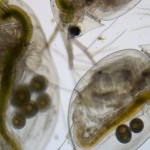
University of British Columbia researchers have identified a small virus that attacks another virus more than 100 times its own size, rescuing the infected zooplankton from certain death. The discovery provides clues to the evolutionary origin of some jumping genes found in other organisms.
Read More ...
Aug. 4, 2010 | Filed under: Media Release, News Feed | Tags: climate change, Darwin, evolution, natural selection, stickleback, zoology
University of British Columbia researchers have observed one of the fastest evolutionary responses ever recorded in wild populations. In as little as three years, stickleback fish developed tolerance for water temperature 2.5 degrees Celsius lower than their ancestors.
Read More ...
Dec. 9, 2009 | Filed under: Media Release | Tags: Amazon, biodiversity, bird, DNA, evolution, land bridge, Panama, zoology
Despite their ability to fly, tropical birds waited until the formation of the land bridge between North and South America to move northward, according to a University of British Columbia study published this week in the Proceedings of the National Academy of Sciences Early Edition.
Read More ...