Researchers have found a way to reduce organ rejection following a transplant by using a special polymer to coat blood vessels on the organ to be transplanted.
Aug 9, 2021
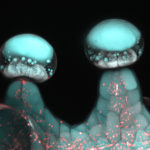
Cannabis flowers with the most mushroom-shaped hairs pack the biggest cannabinoid and fragrance punch, according to new research from the University of British Columbia.
Oct 28, 2019
Research into forest renewal, quantum computer nanotechnology, solar power, high-tech manufacturing, forestry products and the Subarctic ocean climate got a boost today.
Mar 1, 2016
Scientists across an array of faculties at UBC will receive a combined a total of nearly $33 million in grants, fellowships and scholarships, NSERC announced today.
Jun 22, 2015
UBC students and postdoctoral fellows in the fields of biological engineering and bioinformatics have received $3.3 million in grants from NSERC.
May 20, 2015
The number of women registered in first-year engineering undergraduate programs at the University of British Columbia is on the rise, up 61 per cent since 2010.
Feb 20, 2015
Research into salmon, clean drinking water, river ecosystems, and wireless networks at UBC received a $2.2 million boost in funding from NSERC.
Feb 10, 2015
The Pacific Institute of Mathematical Sciences has been awarded $6.25 million in funding from NSERC.
Jul 24, 2014
UBC researchers studying nanomaterials and isotopes received a $3.3 million boost in funding from the Natural Sciences and Engineering Research Council of Canada (NSERC).
May 16, 2014
New lightweight magnesium car parts are helping to cut down emissions.
Mar 26, 2014 - by Heather Amos
Three UBC scientists have received some of the top academic prizes available from NSERC.
Feb 3, 2014
UBC research in fish ecology, oil sands, energy efficient buildings and wearable electronics received a $9-million boost today through NSERC.
Jan 9, 2014
UBC engineers are developing technology to turn rigid electronics into garments that move with you.
Jan 9, 2014 - by Heather Amos
Thirty-three doctoral students and postdoctoral fellows have received $4.8 million in funding through Vanier Canada Graduate Scholarships and Banting Postdoctoral Fellowships.
Oct 3, 2013
With the same technology that carries tunes through the airwaves into your old AM/FM radio, Stavros Avramidis decontaminates wood. It’s a new solution to an old problem.
Jun 17, 2013 - by Heather Amos
The humble fruit fly may have something to teach us about forgoing empty calories for more nutritional ones – especially when we’re hungry.
Oct 16, 2012
By outfitting two British Columbia subspecies of Swainson’s thrushes with penny-sized, state-of-the-art geolocators, University of British Columbia researchers have been able to map their wildly divergent migration routes and pinpoint conservation hotspots.
Sep 25, 2012
University of British Columbia students and postdoctoral fellows in the fields of geochemistry, quantum sciences, and information and communication technology systems received a $4.9-million boost from the Natural Sciences and Engineering Research Council of Canada (NSERC).
Jun 26, 2012
The loss of biological diversity is increasingly threatening the planet’s ability to provide humans with life’s essentials: food, water, fodder, fertile soils, and protection from pests and disease, according to a sweeping review of 20 years of research by an international team of ecologists, including biologists from the University of British Columbia.
Jun 6, 2012
An international team that includes UBC physicists has used ultra-fast laser pulses to identify the microscopic interactions that drive high-temperature superconductivity.
Apr 2, 2012
An information source that gives journalists access to UBC’s expertise.